
What Is Slow Stitching?
Why People Come Even When They’ve Never Done It Before

New here? This is the heart of what I do - slow stitching.
After you read this, you might like to read our Welcome Start here post

Almost everyone who comes to Slow Stitch Saturdays tells me the same thing beforehand.
They say things like:
“I’m not sure I’m going to be very good at this.”
“I haven’t sewn since I was at school.”
“I’ve never done anything like this before.”
Some nearly don’t come at all.
They worry they’ll be the only one who doesn’t know what they’re doing. That everyone else will arrive with neat stitches, confidence, and a clear idea of what they want to make.
What actually happens is something very different.
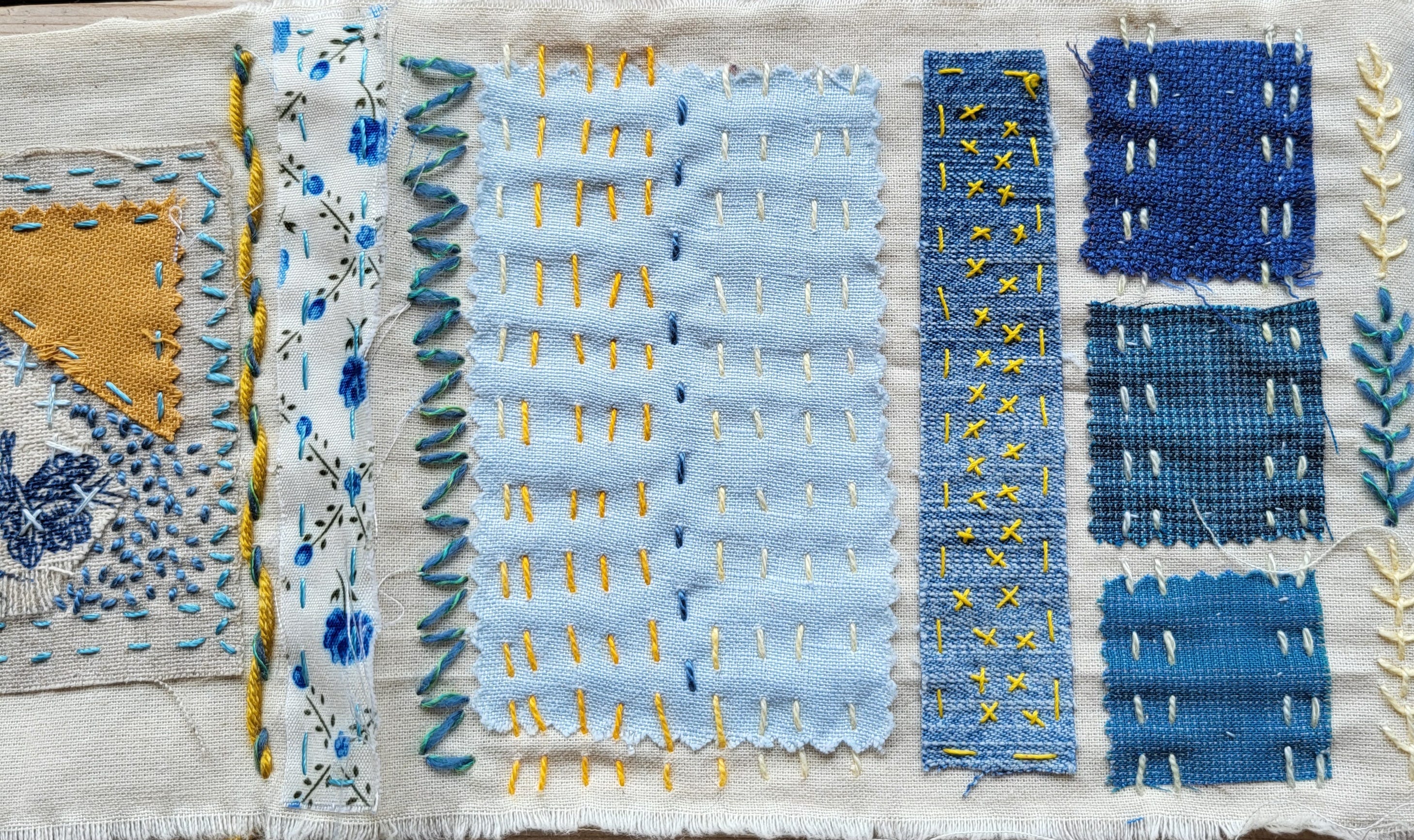
People arrive and nervously choose a seat, uncertain whether they should be there at all.
To reduce that sense of overwhelm, for the first few sessions I place a small paper bag at each place setting, neatly folded over. Everyone’s curiosity is piqued by what might be inside, so much so that they often forget their nerves. A little conversation usually starts around the mystery bags.
Once everyone has arrived, I explain that each bag contains some backing fabric — usually calico — and a few small, co-ordinating fabric pieces that can be arranged in collage style on top.
At the side of the room is a table filled with embroidery threads, ribbons, lace, yarn scraps and beads, along with extra fabric for anyone who wants different colours or textures. I also pass around a few samples of slow stitching I’ve done, not as examples to copy, but simply as inspiration.
I’m always careful to say the same things early on: there are no rules, you can’t make mistakes, you don’t have to finish anything, and this is about enjoying the process and letting the piece evolve.
I often describe slow stitching as doodling with fabric and thread.
It’s not about planning or precision. It’s about responding — placing a stitch, seeing what happens, and then adding the next one. Just like doodling on paper, you follow your curiosity rather than a set of instructions.

I show them how to attach the fabric with a simple, invisible tack, and then let them loose at the table.
By this point there’s usually a lot of excitement and chatter around all the materials. More than once I’ve been told it feels a bit like being a child in a sweet shop.
When everyone settles back down with their fabric and thread, a gentle quiet often takes over while people find their way into their designs. There are a few questions, but not many, because I remind people that there’s no right or wrong way — just what feels right to you.
What’s especially lovely is watching people become inspired by each other. Fabric choices, stitches, small ideas shared across the table. At the end, when I ask if I can take photos of the work, others often do the same, asking permission from one another because they’ve been so inspired.
There are always smiles and thanks at the end of each session, and promises to come back — which many do.
I’ve watched people who were convinced they “wouldn’t like it” relax into the rhythm within minutes. I’ve seen shoulders drop. Breathing slow. Conversation emerge sideways, without effort.
By the end, nobody is worried about whether they’re doing it right anymore. They just want to take a few bits of fabric and thread home with them, to continue stitching. It becomes surprisingly addictive.
Slow stitching doesn’t ask for experience.
It doesn’t ask for talent.
It just asks you to arrive.
And that, it turns out, is enough.
If you enjoyed this post, you might want to read the next post in this series:
Your workshop sounds like a delightful experience.
A great talent